
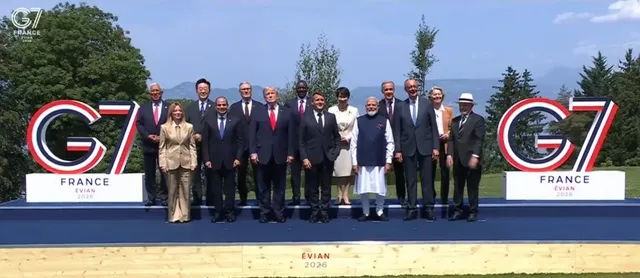
PARIS — Artificial intelligence is becoming one of the most powerful forces shaping the global economy. But as AI capabilities expand, disagreements among the world’s leading economies are also becoming more visible.
Recent G7 meetings revealed that while leaders agree on the importance of artificial intelligence, they do not always agree on how it should be governed.
Some countries want stronger regulation.
Others fear that too many restrictions could slow innovation.
The result is an emerging G7 AI Clash — a debate that could influence the future of technology for decades.
A Race for Global Leadership
Artificial intelligence is no longer simply about creating better software.
Today, AI influences economic competitiveness, national security, industrial policy, and geopolitical influence.
Governments worldwide are investing heavily in research, semiconductor production, cloud infrastructure, and talent development.
Experts believe that leadership in AI could determine which countries dominate the next phase of global economic growth.
As a result, competition is intensifying.
Europe Pushes for Rules
European countries have taken a more cautious approach toward artificial intelligence.
Policymakers across the European Union argue that advanced AI systems should operate within clear legal frameworks designed to protect citizens and preserve trust.
Issues such as transparency, privacy, accountability, and safety remain central to Europe’s AI strategy.
Supporters say regulation will encourage responsible innovation.
Critics argue that excessive oversight could reduce competitiveness.
The Innovation Argument
Other countries, particularly those hosting major technology companies, emphasize the importance of rapid innovation.
Business leaders often warn that strict regulations could discourage investment and slow research.
They argue that artificial intelligence is evolving so quickly that overly restrictive rules may become outdated before they are implemented.
For these countries, maintaining technological leadership is a strategic priority.
Chips, Data and Infrastructure
The AI race depends on more than algorithms.
Advanced semiconductors, high-performance computing systems, energy infrastructure, and access to data are all essential components of AI development.
Many G7 governments are investing billions of dollars to strengthen domestic technology industries and reduce supply-chain risks.
Competition for AI infrastructure has become increasingly intense.
Analysts note that future economic leadership may depend as much on computing capacity as on scientific breakthroughs.
National Security Concerns
Artificial intelligence is also raising important security questions.
Governments are exploring how AI could affect cybersecurity, military capabilities, intelligence operations, and critical infrastructure.
As a result, AI policy is increasingly being discussed alongside national defense and strategic planning.
Several countries have introduced measures designed to protect sensitive technologies and limit potential security risks.
The intersection of AI and national security is expected to remain a major issue in future G7 discussions.
The Search for Common Standards
Despite differences, G7 leaders recognize that international cooperation remains necessary.
Artificial intelligence operates across borders.
Challenges such as misinformation, cyber threats, deepfakes, and AI safety cannot easily be addressed by individual countries acting alone.
Many experts support the creation of common international principles that encourage innovation while reducing risks.
However, achieving global consensus may prove difficult.
Looking Ahead
The G7 AI Clash reflects a broader transformation taking place across the global economy.
Artificial intelligence is becoming a source of both cooperation and competition.
As governments seek to balance innovation, regulation, security, and economic growth, disagreements are likely to continue.
The choices made today may determine how AI develops, who benefits from it, and how its risks are managed.
One thing is certain: artificial intelligence is no longer simply a technology story.
It has become a geopolitical one.